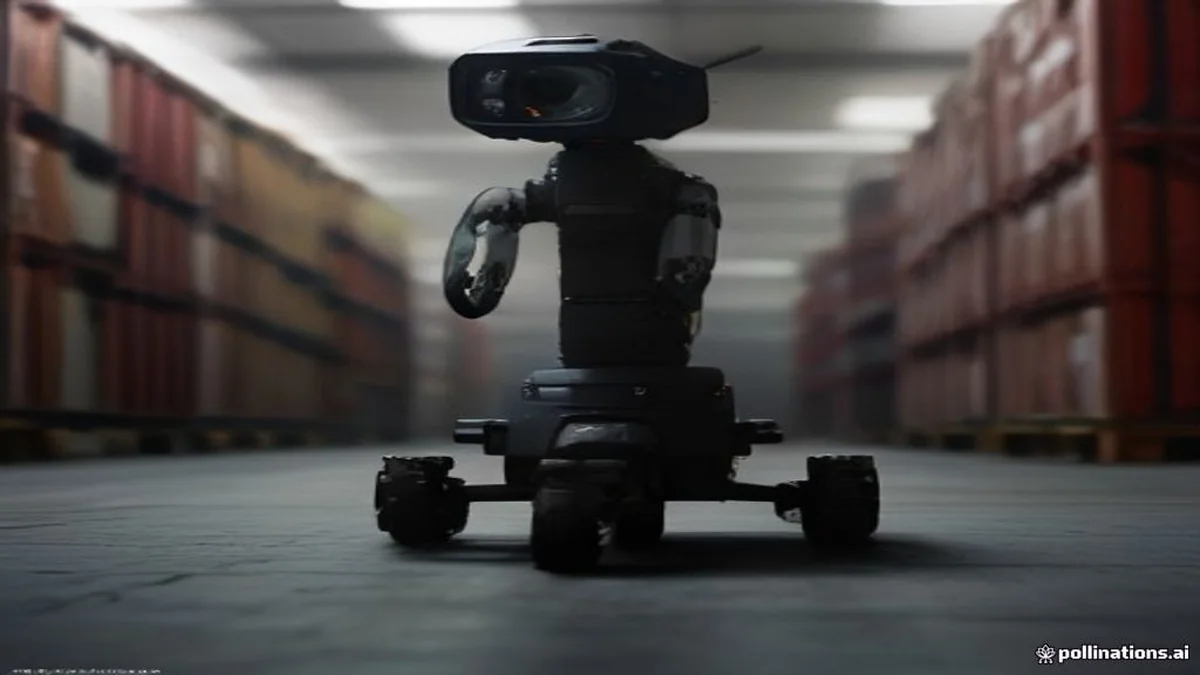
Navigating dynamic, unstructured environments with hybrid mobile systems requires a delicate balance between long-horizon predictive modeling and real-time reflex control. While modern generative world models excel at anticipating the future consequences of navigation actions, their predicted action sequences frequently degrade when confronted with unmapped dynamic obstacles or abrupt terrain transitions. Addressing this critical latency and safety bottleneck, researchers have proposed WAVE-Go, a novel image-goal navigation framework specifically architected for wheel-legged robots that decouples high-level world-action prediction from interruptible, low-level command execution.
Deconstructing World-Action Prediction and Interruptible Command Execution
Traditional vision-language-action (VLA) models and predictive world simulators operate on fixed-horizon rollout strategies, assuming static or predictably changing environments throughout the execution phase. However, when deployed on complex multi-modal platforms combining high-speed wheeled locomotion with legged obstacle traversal, unpredicted pedestrian movements or sudden elevation shifts invalidate pending action tensors instantly. WAVE-Go tackles this failure mode by introducing an asynchronous execution architecture. The world-model backbone continuously infers macro-trajectory goals from onboard RGB-D and LiDAR streams, while an adaptive executor evaluates incoming sensor observations against active motor commands at sub-millisecond intervals.
At the core of this execution engine lies a rigorous conditional-risk formulation. Rather than blindly executing a rigid four-command sequence, the system computes an estimated cumulative failure budget based on real-time slip detection, IMU telemetry, and kinematic joint torque feedback. If the environmental divergence exceeds pre-programmed risk thresholds, the executor dynamically truncates the action prefix, aborts invalid terminal commands, and immediately triggers an optimized recovery or replanning cycle. This mitigates the cascading localization errors typical of closed-loop neural controllers operating without runtime arbitration.
- In-Distribution Success Rate: Reaches 74.1%, outperforming baseline architectures by 4.7 percentage points.
- Dynamic OOD Success: Achieves 63.3% success in dynamic out-of-distribution scenarios, surpassing the strongest comparative model by 7.7 percentage points.
- Collision Mitigation: Reduces collision frequency from 4.4 down to 2.9 incidents per 100 meters of traversed path.
- Replanning Efficiency: Lowers replanning frequency by 51.2% while simultaneously raising overall task success by 4.0 percentage points compared to fixed four-command execution baselines.
"Read it on AI Robot: The integration of conditional-risk budgeting into world-model execution marks a vital architectural shift from open-loop trajectory following to dynamically interruptible physical reasoning."
Kinematic Clearance, Stability Verification, and Locomotion Transitions
Wheel-legged robots present profound control challenges due to their hybrid kinematic configuration. Transitioning between rolling kinematics on flat concrete and quadrupedal stepping over uneven debris requires seamless synchronization between the base chassis velocity controllers and high-DOF leg joint actuators driven by field-oriented control (FOC) BLDC motors. WAVE-Go incorporates multi-stage verification filters that inspect posture stability and locomotion-mode clearance before granting execution approval to predicted action chunks.
Whenever the world model proposes a structural shift—such as deploying leg articulation to vault over an obstacle while maintaining a forward-facing wheel trajectory—the safety layer executes rigorous task-evidence checks. These checks evaluate center-of-mass (CoM) projections against the current support polygon derived from foot-contact sensor arrays. If leg slippage or actuator saturation approaches critical limits, the framework intercepts the command pipeline, enforcing an instantaneous postural freeze or retraction maneuver before destabilization occurs.
Deployment Benchmarks and Embodied AI Integration
Translating academic world-model research into robust physical hardware demands optimized software stacks capable of running inference at edge-compute constraints. WAVE-Go interfaces natively with ROS 2 node graphs, utilizing hardware-accelerated tensorRT pipelines to process high-resolution visual inputs alongside proprioceptive telemetry. Ablation studies on the execution modules reveal a profound operational trade-off: while runtime interruption mechanisms successfully drive down reaction latency and collision rates, they introduce additional computational overhead from frequent task re-evaluations.
As the broader field of Embodied AI moves toward general-purpose real-world deployment, frameworks like WAVE-Go provide a blueprint for harmonizing hallucination-prone generative world models with deterministic safety guarantees. By treating action execution as a conditionally budgeted, interruptible stream rather than an immutable trajectory, wheel-legged platforms gain the fault-tolerance required for autonomous operation in chaotic human-centric environments.
🔗 Recommended Technical Resources & Deep Dive Links
- WAVE-Go arXiv Research Paper ↗ — Read the complete academic preprint detailing the mathematical formulation and experimental evaluation of WAVE-Go.
- WAVE-Go GitHub Repository ↗ — Access the official implementation code, configuration files, and deployment scripts for wheel-legged world-model navigation.
- ROS 2 Official Documentation ↗ — Explore the middleware framework utilized for real-time robotic node communication and hardware abstraction.