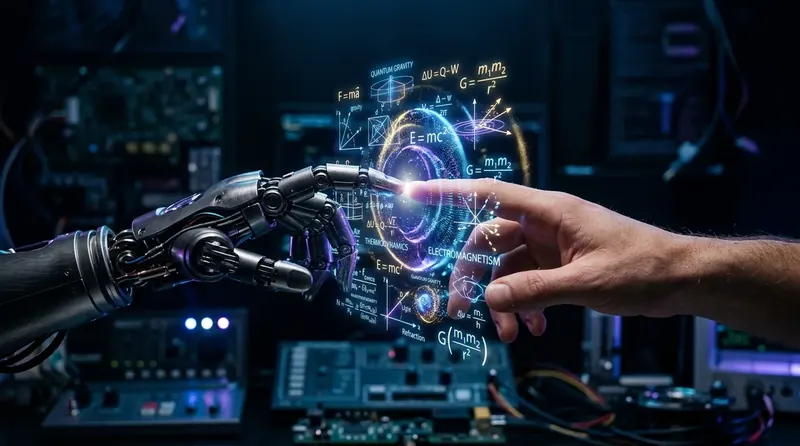
The intersection of representation learning and embodied robotics has hit an architectural crossroads. While generative video diffusion models like Sora and pixel-reconstruction architectures dazzle in synthetic benchmarks, deploying them on real-time robotic hardware reveals insurmountable physical limits. In response, modern Physical AI is converging on Stable Latent World Models powered by Joint-Embedding Predictive Architectures (JEPA). By predicting trajectories directly within compact mathematical state spaces rather than rendering visual pixels, autonomous robots can anticipate forces, friction, and inertial collisions at control frequencies exceeding 100 Hz.
The Pixel Fallacy: Why Visual Rendering Fails Under Real-World Latency
Over the past three years, attempts to ground foundation models in robotics relied on predicting the next optical video frame ($t+1$). While intuitive, this approach forces compute clusters to hallucinate background lighting, wallpaper textures, and irrelevant shadows. For an industrial manipulator arm or a quad-rotor navigating tight corridors, computing millions of non-causal pixel values introduces over 150 milliseconds of inference lag—an eternity when a dynamic joint is approaching singular kinematic boundaries.
Furthermore, pixel-space prediction suffers from mathematical degradation under sensor noise and outdoor glare. Mean squared error losses over raw RGB arrays inevitably blur predicted obstacles when uncertainty spikes. Latent world models eliminate the image decoder entirely. Sensory perception is mapped into an invariant embedding vector where physical laws—such as momentum conservation, joint velocity limits, and contact force vectors—are modeled as smooth, continuous, and differentiable trajectories.
- Sub-10ms Inference Cycles: State-space prediction runs within localized GPU memory bounds, unlocking true Model Predictive Control (MPC) without cloud offloading.
- Invariance to Optical Artifacts: The architecture filters out flickering factory lights and cosmetic shifts, isolating rigid-body dynamics and compliant mechanics.
- Covariance Regularization: Techniques such as VICReg enforce variance across latent dimensions, mathematically preventing the representation collapse seen in contrastive frameworks.
- Proprioceptive Fusion: Direct integration of motor torque telemetry, IMU acceleration curves, and joint encoder angles alongside Vision Transformer (ViT) patches.
"Read it on AI Robot: The future of physical artificial intelligence is not about teaching machines to paint pictures of the future—it is about empowering them to predict the kinetic constraints of reality inside a stable latent space."
JEPA and Action-Conditioned Dynamics in Unstructured Environments
In a standard JEPA pipeline, an encoder processes current sensor observations into state vector $s_t$. A transition predictor then accepts $s_t$ alongside a proposed motor action $a_t$, generating predicted latent state $hat{s}_{t+1}$. Crucially, training is self-supervised using energy-based loss functions that reward causal consistency while penalizing informational redundancy.
This formulation allows robots to conduct hundreds of internal "mental simulations" within fractions of a second. Instead of physically executing trial-and-error routines on fragile actuators or relying exclusively on rigid physics simulators like Isaac Sim or MuJoCo, the machine evaluates candidate trajectory branches $(hat{a}_t, hat{a}_{t+1}, dots, hat{a}_{t+k})$ directly inside embedded DRAM.
Bridging VLA Foundation Models and Robotic Deployment
The practical implication for Vision-Language-Action (VLA) systems is transformative. Early VLA implementations acted as reactive feed-forward heuristics: an image and prompt yielded an immediate motor torque. Incorporating latent world models gives foundation policies internal physical intuition. When commanded to 'fasten the high-voltage cable harness', the robot internally evaluates the cable's bending stiffness and potential slip angles before engaging gripper pressure.
As open-source implementations proliferate across robotics laboratories globally, the divide between pure software intelligence and mechanical embodiment is closing. Stable latent world models represent the necessary bridge from scripted automation to autonomous physical agents capable of operating safely in unpredictable human environments.
🔗 Recommended Technical Resources & Papers
- A Path Towards Autonomous Machine Intelligence (Yann LeCun, JEPA Paper) ↗ — Seminal research proposal on non-generative joint embedding predictive architectures for world models.
- OpenVLA Official Project & Weights ↗ — Open-source generalist vision-language-action model trained on cross-embodiment robot datasets.
- Hugging Face LeRobot Repository ↗ — State-of-the-art imitation learning and real-world policy training library in PyTorch.